The Iberian Microplate Goes Its Own Way
Explore a unique corner of geology and continental drift. Immerse yourself in the fascinating world of the Iberian microplate and discover its unusual history. This space is dedicated to understanding its formation, movements and influence on the shaping of the landscape. Join us in this geological exploration.

The formation of the Iberian Peninsula is a geological process spanning billions of years, beginning in the Archaean Era or Precambrian (more than 4,000 million years ago) and continuing to the present day.
However, the key stages that gave it its present shape and relief are as follows:
-
Primary Era or Palaeozoic (600 to 225 million years ago):
-
The Variscan or Hercynian Orogeny takes place, a continental collision that raised a large mountain range.
-
This orogeny was responsible for the formation of the Hesperian Massif (which today forms the core of the Central Plateau and its basement).
-
By the end of this era, erosion had levelled these landforms, turning them into a rigid basement.
-
-
Secondary Era or Mesozoic (225 to 68 million years ago):
-
It was a period of orogenic calm. Erosion of the massifs and sedimentation predominated.
-
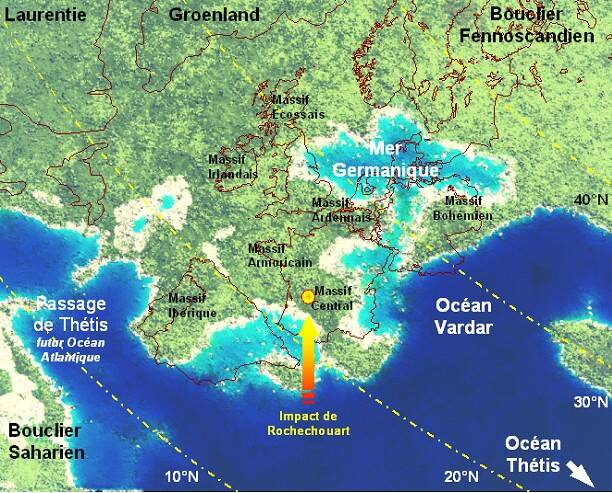
Much of the territory was submerged beneath the Tethys Sea, where enormous thicknesses of sediment were deposited, especially in the areas that are now the Pyrenees and the Baetic Ranges.
-
-
Tertiary Era or Cenozoic (68 to 1.7 million years ago):
-
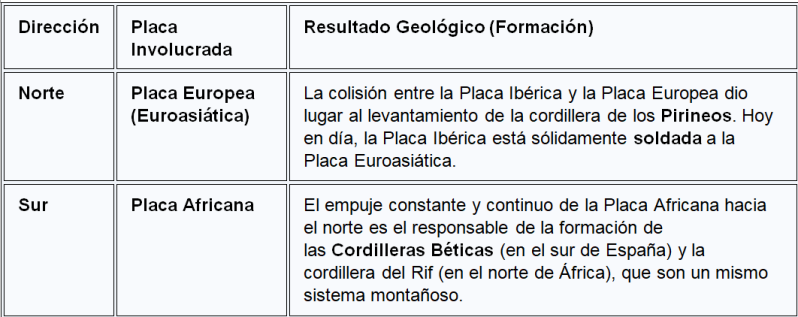
The Alpine Orogeny occurs, caused by the collision of the African Plate with the Eurasian Plate.
-
This intense tectonic movement generated today's major landforms: the sediments deposited in the Secondary Era were folded, giving rise to young, high mountain ranges such as the Pyrenees and the Baetic Ranges.
-
The ancient, rigid Hesperian Massif (the Plateau) fractured and its edges were uplifted, forming systems such as the Central System, the Iberian System and the Cantabrian Mountains.
-
In summary, although its origins date back to the Precambrian, the peninsula's present shape is chiefly the result of the Variscan Orogeny (Palaeozoic) and, above all, the Alpine Orogeny (Cenozoic).
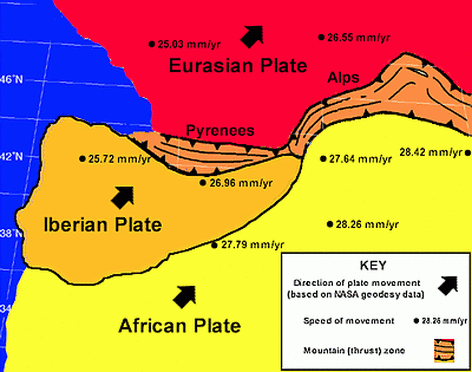
The Iberian Peninsula's location is exceptionally interesting from a geological perspective, as it lies at a crucial point of convergence between two major tectonic plates: the Eurasian Plate (Europe) and the African Plate (or Nubian Plate).
Essentially, the Iberian Peninsula is the visible part of a microplate (the Iberian Plate) that has historically acted as an intermediate piece between the two continents.
Summary of Its Relative Position and Evolution:
-
The Peninsula as a Tectonic Microplate
During the formation of the supercontinent Pangaea (Primary Era), Iberia was part of it. However, its position became unique from the Mesozoic (Secondary Era) onwards:
-
Anticlockwise Rotation (Cretaceous): The Iberian Peninsula separated from the Eurasian Plate and rotated anticlockwise, opening the Bay of Biscay. During this time, Iberia moved relatively independently.
-
The Collision (Alpine Orogeny)
The peninsula's present shape and relief (Tertiary Era or Cenozoic) are the direct result of the compression generated by the convergence of the plates:
-
-
Present Situation: An Active Convergence Zone
The African Plate has not stopped. Today, the Iberian Peninsula lies in a zone of residual compression due to the African Plate's continuing northward movement at a rate of between 2 and 5 millimetres per year.
-
The Geological “Kiss”: This convergence is particularly evident in the Alboran Sea and the Strait of Gibraltar, which mark the boundary between the African Plate and the Eurasian Plate (including Iberia).
-
Seismicity: This constant process of collision causes seismic activity in the south and southeast of the peninsula (especially in the Baetic Ranges and the Alboran Sea).
In summary, the Iberian Peninsula occupies a “pincer” position between two large continental masses, and its relief is the scar left by the collisions that formed it and welded it to Europe, while Africa continues to push from the south.
The Iberian Plate became firmly joined to the Eurasian Plate during the Alpine Orogeny in the Cenozoic (or Tertiary) Era, specifically during the formation of the Pyrenees.
-
From a geological perspective, the Iberian Plate is considered to have become structurally joined, or “welded”, to the Eurasian Plate in the north at the end of the main phases of uplift of the Pyrenees, during the Cenozoic.
Today, the Iberian Peninsula and the rest of Europe move southwards as a single unit, with the most active plate boundary in the south, where convergence with Africa continues.
The Iberian Plate (sometimes described as a microplate or a block) had a period in which it was “free” or, more precisely, distinct and drifting, moving independently of the Eurasian and African plates.
This period occurred mainly during the Cretaceous (part of the Mesozoic Era), approximately between 100 and 65 million years ago.
Becoming Distinct and Drifting
-
Separation from North America and Africa: As the supercontinent Pangaea fragmented, the Atlantic Ocean began to open. This separated the future Iberian Plate from the North American Plate and, temporarily, from the African Plate as well.
-
Opening of the Bay of Biscay: The Iberian Plate underwent anticlockwise rotation. This rotation was crucial because it opened the crust along its northern margin, creating the oceanic basin that is now the Bay of Biscay.
-
Drifting Microplate: During this movement, Iberia essentially behaved as a microplate separated from the rest of Europe by an arm of the sea (the Pyrenean Trough). Its geological boundaries were active faults (such as the Biscay Fault to the north and the future Baetic zone to the southeast) and the Mid-Atlantic Ridge to the west.
-
End of Independence: This stage of free drift ended when the African Plate's general northward movement began to “push” Iberia. This reversed its separating movement and caused it to collide with the Eurasian Plate, initiating the Alpine Orogeny (formation of the Pyrenees) and its subsequent “welding” to Europe.
Therefore, although it was never completely isolated from the influence of other plates, it was distinct and rotating differently from its neighbours during the Cretaceous, which is considered its period of independent drift.
The history of the Iberian Plate is very ancient and complex, as it has been joined to different continental masses in different geological eras.
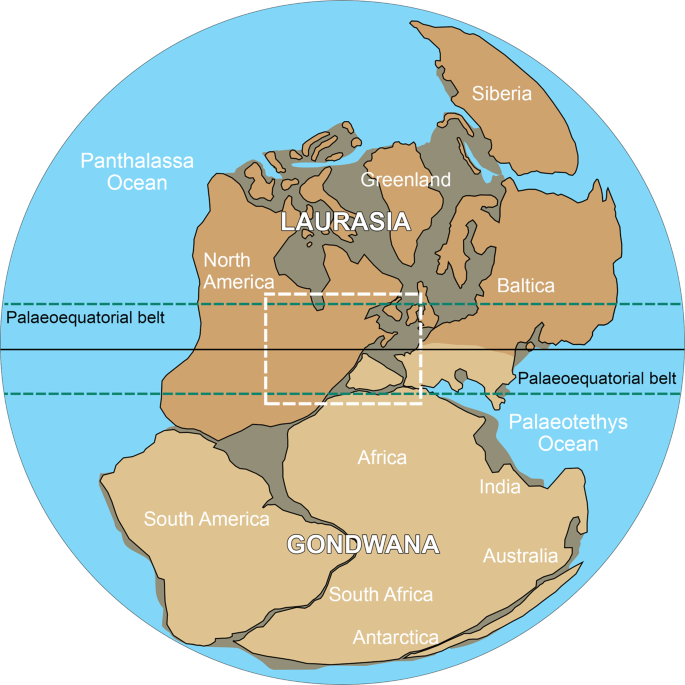
Before its period of rotation and semi-independent drift during the Cretaceous (around 100 million years ago), the Iberian Plate was joined to parts of the two major supercontinents that formed Pangaea:
-
In the Palaeozoic Era (Before Pangaea)
Initially, the territory forming the oldest basement of the Iberian Peninsula (the Hesperian Massif) is considered to have been part of the large southern supercontinent called Gondwana.
-
During the Formation of Pangaea (Late Palaeozoic)
Gondwana's collision with Laurasia (the northern supercontinent containing what is now North America and Eurasia) formed Pangaea through the Variscan or Hercynian Orogeny. The Iberian Plate essentially became a piece embedded in Laurasia's southern margin.
-
Just Before Its Drift (Early Mesozoic)
Once Pangaea had formed, the Iberian Plate was directly joined to:
-
The Rest of Europe (Laurasia): Its most direct connection lay to the north, with what is now the French continental shelf (Brittany). Iberia's subsequent rotation resulted from the opening of the Atlantic, separating it from this mass.
-
North America: Before the Atlantic Ocean opened completely, Iberia was in contact with or very close to the North American coast, and its separation from it was a key process in its subsequent drift.
In summary, before its phase of “floating in isolation”, it was fully integrated into the supercontinent Pangaea, forming a single block with what are now Europe and North America. It became distinct when Pangaea's breakup turned it into a microplate.